|
NAGASE YOSHIRO (1891-1978
) |
|
Born in Sakuragawa
City, Ibaraki Prefecture. He learned western- |
|
style painting at Hakubakai
Institute and then at Tokyo Art College. |
|
He soon quitted the
college and started offering the top page picture |
|
and illustrations for
the Sosaku-Hanga Magazine, " Holy Grail"( later |
|
re-titled " Mask"
)His next step was to organize Japan Hanga Club |
|
with Hasegawa Kiyoshi
and Hiroshima Shintaro. In 1922 he published |
|
" To Those Who
Make Prints" , which gave great influence upon other |
|
artists including Taninaka
Yasunori. |
|
参考資料: |
|
INAGAKI TOMO-O (1902-1980
) |
|
Born in Tokyo in 1902,
Inagaki started to contribute his woodblock works for |
|
the magazine 'Poems
and Prints' in 1923. This challenge acquainted him with |
|
Onchi Koshiro and enabled
him to learn a great deal from this giant in hanga. |
|
His work was first
exhibited in 1924 in the 6th Exhibition of the Sosaku-hanga |
|
Association. 'Modern
Japanese Prints' by Oliver Statler 1957, the first book |
|
to introduce Sosaku-hanga
on the international scale, aroused the world-wide |
|
interest in this genre
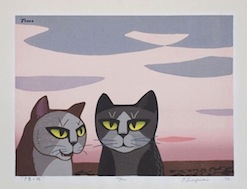
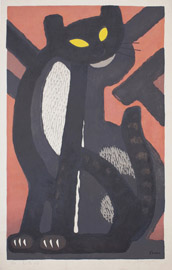
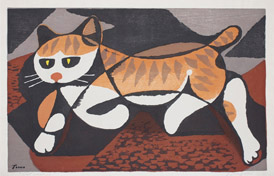
of art. Inagaki's 'Cat making up' was selected to decorate |
|
the front cover, which
helped to bring him international fame. |
|
参考資料: |
|
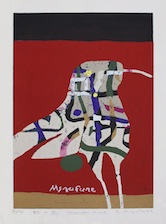
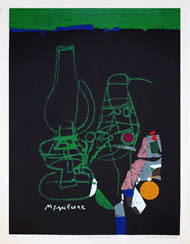
.MIZUFUNE ROKUSHU (1912-1980 ) |
|
1912 |
He entered the Sculpture
Course of Tokyo School of Fine Arts |
|
1931 |
While he attended it,
he also learned under Hiratsuka in his hanga |
|
|
study group together
with Muto Rokuro and Yoshiwara Masamichi. |
|
1932 |
He joined to establish
<Shin Hanga Syudan(The New Print Group)>. |
|
|
This group was restarted
as <Zoukei Hanga Kyokai> in 1938. |
|
1936 |
He graduated from Tokyo
School of Fine Arts |
|
1959 |
and became member of
Japan Print Association. |
|
1960-77 |
He worked as headmaster
of Kanto Gakuin Primary School |
|
|
|
|
Although only watercolor
pigments are used in his woodcut works、they often |
|
exceed oil paintings
in their vivid expression. |
|
The artist says; Any
print or sculpture first comes to me as a form of poetry. |
|
|
|
|
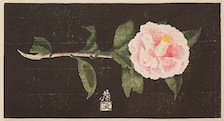
KAMEI TOUBEI (1901-1977
) |
|
|
|
Kamei was born in Yuasa-cho,
Wakayama pref. and named Eiichi, but in 1953 he chose Genbei |
|
as his artist name
and later Tobei. He learned traditional Japanese painting in
Kyoto Art School |
|
and from this early
period worked on making prints. He exhibited his works at the
exhibitions |
|
of Kokuga Creation
Association, Teiten and Shunyo-kai. He was one of the starting
members of |
|
Kyoto Creative Print
Association. Kamei's spiritual master was Kawabata Ryushi and
and joined |
|
his Seiryusha Group
in 1937. He lived and worked in Kyoto until his death in 1977. |
|
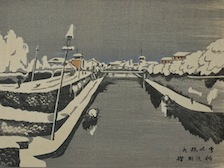
.ASADA BENJI (1900 -1984 ) |
|
1900 |
.Born in Kyoto. |
|
1924 |
.Graduated from Kyouto City Art College. |
|
1928 |
Published the print
magazine "Han(Print)" with Munakata and other artists. |
|
1929 |
.Organized Kyoto Sosaku-Hanga Assosiation with Tokuriki
Tomikichiro, |
|
|
Asano Tkeji and Kamei
Toubei. |
|
1930 |
.Published the print magazine "Kitsutsuki "
with Onchi Koushiro and others. |
|
|
Published the series
of 12 wood block prints titled "New Views of Kyoto" |
|
|
with Tokuriki and Asano. |
|
1977 |
.Published "Brief Sketches of Paris", a series
of essays. |
|
.SEKINO JUN'ICHIRO (1914-1988 ) |
|
.Born in Aomori Prefecture in 1914, he was so fascinated
with woodblock prints |
|
.when he was still attending junior highschool that he
had enough vigor to recruit |
|
.other.members
and edit a hanga magazine. Under Kon Junzo he learned etching |
|
.and lithography. In 1920 he exhibited his work in the
2nd Exhibition of Japan |
|
.Hanga Association. In 1939 he moved to Tokyo and lived
in the neighborhood of |
|
.Onchi Koshiro. |
|
.Together with Yamaguchi Gen, he was founding member
of Ichimoku-kai and for |
|
.about 10 years, surrounding Onchi, made efforts to sustain
this precious circle. |
|
.His two books, 'The Founders of Hanga' and 'The Memorable
Print Artists' are. |
|
.both very valuable documents of sosaku-hanga. |
|
|
| . |
.NAKAGAWA ISAKU (1899-2000 ) |
|
Born in Kyoto in 1899,
he first learned woodblock printing, together with |
|
Tokuriki Tomikichiro,
Asada Benji, Asano Takeji, in the class Hiratsuka |
|
Un'ichi taught. |
|
1928 He exhibited 'Higuruma'
at the 7th Kokuten Exhibition. He was just |
|
1928 transferring from Nihonga (Japanese Style Painting)
to hanga. |
|
1931 He started a hanga
magazine 'Taishu Hanga' with the view of popular |
|
1931 -izing hanga in Kyoto. |
|
1972 He started pottery
in Namban style in Okinawa and made his second |
|
1972 debut as a potter. |
|
|