|
|
|
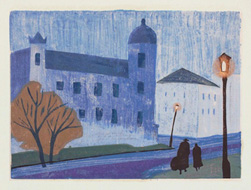
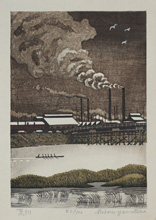
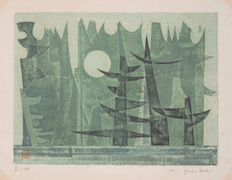
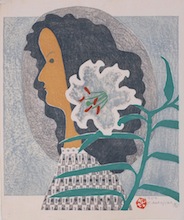
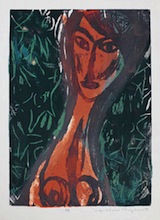
FUKUSHIMA ICHIRO ( 1920-1975 ) |
|
|
Fukushima was born
in 1920 in the Island of Enoshima in Kanagawa Prefecture. |
|
|
From1937 on he learned
art under Ota Koji, who introduced him to Azechi Umetaro. |
|
|
Azechi"s works
totally inspired him to open the door to the world of hanga. |
|
|
Two years later, ini1964, his work
won the Fresh Talent Award in the exhibition |
|
|
of Japan Print Association.
His later works were also welcomed to various |
|
|
international print
exhibitions. |
|
|
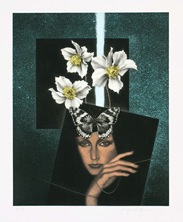
ARAI RYO ( 1933- 2009) |
|
1933 |
Born in Tochigi Prefecture. |
|
1957 |
graduated from Tokyo
Art College as a design major. |
|
1958 |
became a member of
Japan Advertisement Art Association |
|
1962 |
started working as
a designer for Hitachi Electric Appliances, |
|
|
Seibu Department Store,
Isuzu Automobile, and IBM. |
|
1975 |
started copperplate
printing. |
|
1983 |
signed a contract with
Franconi, a print publisher in Paris. |
|
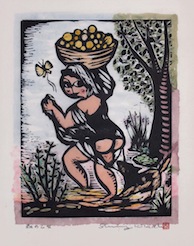
HATSUYAMA SHIGERU (
1897-1973 ) |
|
Born in Asakusa district,
Tokyo, he learned at the age of ten the traditional |
|
|
Yamoto-e painting from
Kano Tanrei. He then worked in a dye house, where |
|
|
he made full use of
his drawing ability. In1919 he started to draw pictures |
|
|
for children when the
magazine " The World of Fairy Tales " was published. |
|
|
His fairy tale picures,
with delicate lines and decorative compositions, were |
|
|
soon hily valued. He
started woodblock printing in the 1930s. |
|
|
|
|
|
ISHII TSURUZO ( 1887-1973
) |
|
Born in Tokyo in 1887
as a son to Ishi Teiko, a famous traditional-style artist, |
|
|
Ishi Hakutei, Teiko's
first son and Tsurozo's elder brother, also established fame |
|
|
as an artist. Tsurozo
learned sculpture in Tokyo Art School and became a member |
|
|
ofJapan Art Institute. Tsuruzo^s
ability to lead artists of younger generations |
|
|
always brought him
in the center of many art groups such as Japan Print Association, |
|
|
Japan Creative Print
Association, Japan Watercolor Society, Shunyokai Group. |
|
|
After World War II,.hhe taught at
Tokyo University of the Arts. |
|
|
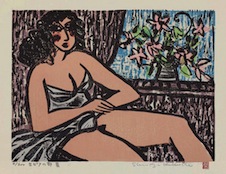
YAMATAKA NOBORU ( 1926-
) |
|
Born in Tokyo in 1926,
he graduated from Meiji University in 1945. |
|
|
His major was Japanese
literature. While he was working for a publishing |
|
|
company, he started
to learn woodblock printing by himself around 1962. |
|
|
In 1978 he left the
company and devoted himself to making prints. |
|
|
His works were exhibited
at Yujin Gallery in 1980, titled "Japanese |
|
|
Sensibility; The Worlds
of Kawakami Sumio and Yamataka Noboru" |
|
|
He also left many book-cover
designs. |
|
|
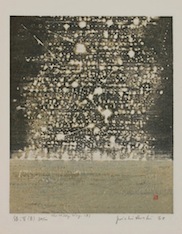
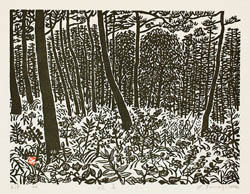
HOSHI JOICHI ( 1913-1979
) |
|
Born in Niigata pref.,
Hoshi graduated from Tainan Education College in Taiwan in |
|
|
1932 and.worked there as
a teacher for 13 years. After leaving Taiwan in 1946, |
|
|
he started printing
business in his home town and also started making lithographic |
|
|
art works. In 1956
he graduated from Musashino Art College as an oil painting |
|
|
major and learned for
himself woodblock print techniques. In 1959 he was awarded |
|
|
the.Kokuga-kai Prize for his work " Water".
Most of his works surround the themes |
|
|
of trees ans woods
and.stars
and constellations. |
|
|
|
|
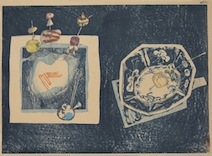
KAWARA KANJI ( 1897- last year
unknown ) |
|
|
Kawara was born in
Ako, Hyogo Prefecture in1897。He learned oil painting at Hongo |
|
|
Institute of Western
Art in Tokyo. He left the Institute midway and started to work
as |
|
|
a news reporter for
the Hochi Newspaper. The best-known of his talents may have |
|
|
been that of an actor
both in the theater and in the movies. The two giants in the
acting |
|
|
world, Kishida Kokushi
and Ozu Yasujiro higly valued him for his refined silvery manners. |
|
|
He was a member of
Japan Print Association between 1954 and 1973. |
|
|
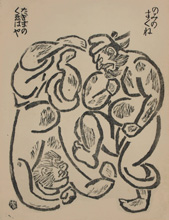
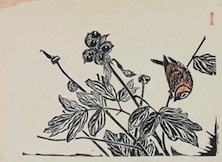
SASAJIMA KIHEI ( 1906-1993
) |
|
1906 |
Born in the pottery
town of Mashiko, Tochigi prefecture. |
|
1936 |
He attended a course
given by Hiratsuka Un'ichi and was fascinated |
|
|
with the world of black
and white woodblock prints. |
|
1937 |
Hamada Shoji, a well-known
potter living in Mashiko, introduced him |
|
|
to Munakata Shiko,
giving him the great oppotunity because he had |
|
|
always admired Munakata's
works for their feeling of incredible liberty. |
|
1952 |
He joined Munakata Shiko and Shimozawa
Kihachiro to form Nihon |
|
|
Hanga-in. |
|
|
|
|
|
|
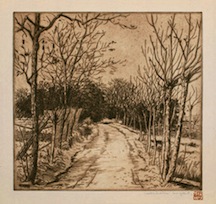
.SOGAO TAKEHARU ( 1899-1984 ) |
|
1915 |
Sogao learned in The
Hongo Art Institute under Nagahara Kotaro and |
|
|
his oil painting was
exhibited at a Kofukai Exhibition. |
|
c.1930 |
He started learnig
etching techniques and, after the contacts with |
|
|
Nishida Takeo and Kon
Junzo, made efforts to spread this new medium. |
|
1940 |
He was elected to attend the managing
board of The Association of |
|
|
Japanese Etchers. |
|
1960 |
He joined Japan Hanga
Association, which had been established by |
|
|
10 members including
Munakata Shiko, Maekawa Sempan and Nagase |
|
|
Yoshiro. |
|
|
|