|
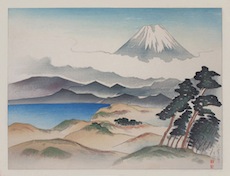
KAWABATA RYUSHI (1885-1966) |
|
Born in 1885 in Wakayama
City and was named Ryutaro. |
|
He first learned Western-style
painting at the two major |
|
institutes, Hakuba-kai
and Taiseiyoga-kai. |
|
He visited the Boston Museum in
1913 and was deeply fasci- |
|
nated by the classic Japanese picture
scroll, Heiji Monogatari. |
|
This experience moved him to change
his career to a Japanese- |
|
style painter. He was
awarded a Culture Medal in 1959. |
|
ICHINO TATSUOKI (1942-1997) |
|
1942 |
Born in Aichi Prefecture. |
|
1960 |
Learned Japanese=style
painting under Kawabata Ryushi |
|
|
and was active in the
Seiryusha Group. |
|
1966 |
After this group.was
dissolved, he learned under Takayama |
|
|
Tatsuo. His work was
accepted and exhibited at Nitten Exhibition. |
|
1974, 1976 |
Awarded the Special
Prize at the Nitten Exhibitions. |
|
1981 |
Ellected a member of
the Judging Commity of Nitten Institute. |
|
|
|
|
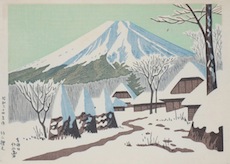
.SEKINO JUN' ICHIRO ( 1914-1988 ) |
|
.Born in Aomori Prefecture in 1914, he was so fascinated
with woodblock prints |
|
.when he was still attending junior highschool that he
had enough vigor to recruit |
|
.other.members
and edit a hanga magazine. Under Kon Junzo he learned etching |
|
.and lithography. In 1920 he exhibited his work in the
2nd Exhibition of Japan |
|
.Hanga Association. In 1939 he moved to Tokyo and lived
in the neighborhood |
|
.of Onchi Koshiro. |
|
.Together with Yamaguchi Gen, he was founding member
of Ichimoku-kai and for |
|
.about 10 years, surrounding Onchi, made efforts to sustain
this precious circle. |
|
.His two books, 'The Founders of Hanga' and 'The Memorable
Print Artists' are. |
|
.both very valuable documents of sosaku-hanga. |
|
|
|
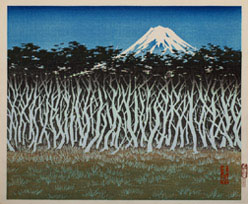
.FUKUSHIMA ICHIRO ( 1920-1975 ) |
|
1920 |
Born in Enoshima, Kanagawa
Prefecture. |
|
1937 |
He learned under Ota
Koji and was enlisted in The Art Training Center |
|
|
at Kumaoka. Later,
accompanied by Ota Koji, he met Azechi Umetaro |
|
|
and was fascinated
by his works and his spirit. |
|
1962 |
He started making prints. |
|
1964 |
He exhibited his works
in the Exhibition of Japan Hanga Association |
|
|
and won the Newcomer
Prize. He developed and deepened his art |
|
|
while participating
in various international exhibitions |
|
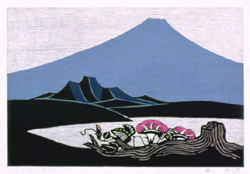
.KITAOKA FUMIO ( 1918 -2007 ) |
|
1918 |
Kitaoka Fumio was born
in Tokyo in 1918. |
|
1939 |
He learned woodblock
printing under Hiratsuka Un'ichi during his |
|
|
student years in Tokyo
School of Fine Arts, and in the same year |
|
|
his work was first
admitted entry for the Exhibition of Japan |
|
|
Hanga Association. |
|
1942 |
He joined the 'Kitsutsuki-kai'
group led by Hiratsuka and in 1943 |
|
|
became member of the
Hanga Association. |
|
1944 |
He joined the 'Ichimoku-kai'
group whose leader was Onchi Koshiro. |
|
1955 |
He went to France and
met Hasegawa Kiyoshi, who became his third |
|
|
great teacher. |
|
1964-6 |
During the 1964-65
period, he taught woodblock printing at |
|
|
Minneapolis School
of Art and at New York Brat Graphic Art Center |
|
|
as a Fulbright exchange
professor. |
|
2007 |
He passed away on April 22 at the
age of 89. |
|
|
|
|
|
|
|
YAMAGISHI KAZUE ( 1891
-1984 ) |
|
|
Yamagishi was born
in Ina City, Nagano Prefecture, in1891. After graduating |
|
|
from primary school,
he moved to Tokyo and learned woodblock print-making. |
|
|
From1913 to 1916 he
worked for The Yomiuri Newspaper Company as a |
|
|
wood-carver in the
process of illustratimg the pages. For several years fom 1926 |
|
|
he traveled around Europe and the
US and published many prints depicting scenic beauty. |
|
|
He remained very active
until he passed away at the age of 94 |
|
|
|
|
|
ASANO TAKEJI ( 1900 - 1998 ) |
|
|
Born in Kyoto in 1900,
Asano learned Nihonga (Japanese-style painting) at Kyoto City |
|
|
School of Fine Arts. Though
he took up Western-style oil painting for some time, he |
|
|
soon resumed his career
as a Nihonga artist. |
|
|
In 1928, he attended
Hiratsuka's seminar at Gasendo in Kyoto and then was fully devoted |
|
|
to printmaking together
with Tokuriki Tomikichiro, Asada Benji and Nakagawa Isaku. |
|
|
Stimulated by Kobayashi
Kiyochika's series 'Famous Places of Tokyo', which he felt was |
|
|
full of realistic charm,
he started his own version of 'famous places' series. At the
same |
|
|
time he fully used
his imagination for his sosaku hanga works. In his post-war years |
|
|
he advocated Jiyu Hanga
(literally Free Will Print). |
|
|
|
|
|
|
|
|
NAKAGAWA MOKUREI (1919-1979
) |
|
|
Born in Murokawa, Yamagata
prefecture. In his youth while he was devoting himself |
|
|
to wood curving, Kataoka
Mito, a sculptor known for his traditional painting and wood |
|
|
works, found him and
advised him to learn in Tokyo. After World War II, he joined
a |
|
|
project team making
reprints of traditional woodblock prints. |
|
|
He was selected as
a 'human treasure' in the field of traditional woodblock curving
by |
|
|
the Tokyo Metropolitan
Government. |
|
|
HIRATSUKA UN'ICHI (
1895 -1997 ) |
|
He was born in Matsue
City in 1895. On the advice of Ishii Hakutei, his master in |
|
the fine arts, he learned
the carving techniques under Igami Bonkotsu, a renowned |
|
carver. Hiratsuka himself
was later called a master carver. .In 1921 his work was |
|
first exhibited in
the 3rd Exhibition of the Sosaku-hanga Association. |
|
Throughout his long
career he never spared any effort to promote this genre of art. |
|
He not only worked
as a lecturer at the government academy, Tokyo School of Fine |
|
Arts, but he also started
lectures and workshops throughout the country, thus cul- |
|
tivating the soil on
which grew many talents. Among them we find Munakata Shiko |
|
as well as Azechi Umetaro,
Maeda Masao and Shimozawa Kihachiro..The latter three |
|
were called the three
outstanding talents in the Hiratsuka school. |
|
Un'ichi's passion for
hanga never waned until his death at the age of 102 in 1997. |
|
|
|
|
|
|
KAKIHARA TOSHIO (1893
-1960 ) |
|
|
He was one of Hiratuka's
students. The catalogue of the 3rd Exhibition of Japan Print |
|
|
Association says that
he was born in Sendai in 1897, but our further research made
in |
|
|
Sagamiko-cho, Kanagawa
Pref., where he died, shows that his birth year was 1893. |
|
|
It might have been
that he declared his age a little younger than he really was
becuase |
|
|
he wanted to be among
the younger artists he felt spritual kinship to. The portrait
that |
|
|
Maeda Masao made of
him is shown in 'Han News No.6 ' featuring Maeda Masao. |
|
|
|
|
|
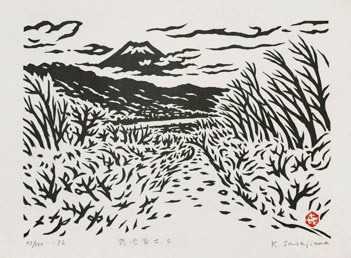
SASAJIMA KIHEI ( 1906-1993
) |
|
1906 |
Born in the pottery
town of Mashiko, Tochigi Prefecture. |
|
1936 |
He attended a course
given by Hiratsuka Un'ichi and was fascinated with |
|
|
the world of black
and white woodblock prints. |
|
1937 |
Hamada Shoji, a well-known
potter living in Mashiko, introduced him to |
|
|
Munakata Shiko, giving
him the great oppotunity because he had always |
|
|
admired Munakata's
works for their feeling of incredible liberty. |
|
1952 |
He joined Munakata
Shiko and Shimozawa Kihachiro to form Nihon Hanga- |
|
|
in (Japn Print Accademy). |
|
|
|