|
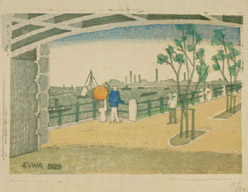
.HIRAKAWA SEIZO (1896-1964 ) |
|
Born in Onomichi City,
Hiroshima Pref. Hirakawa learned Western-style woodblock |
|
print techniques from
Hashimoto Kenzo, which led him to become a print artist. |
|
He exhibitted his work
at the 2nd exhibition of Japan Sosaku-hanga Association in |
|
1920, and in 1926 he
made public two of his best known works, " On the Campus |
|
of the Emperial University
" and "Woman Playing the Mandoline" |
|
In 1928 he became member
of Japan Sosaku-hanga Association, and in 1932 published |
|
"Collection of
Small Prints" (8 woodblock prints completed between 1929
and 1932) |
|
(limited edition of
20). |
|
In1954 he engraved
"Cormorant Fishing" and some other pictures by Kawase
Hasui. |
|
|
|
Han News vol.2, "Hirakawa
Seizo", Kikai 1994 |
|
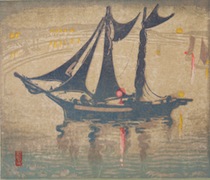
KAWAKAMI SUMIO (1895
-1972 ) |
|
Born in Yokohama City.
After graduating from Aoyama Gakuin High School, |
|
he enjoyed a long travel
around North America including Canada without any |
|
definite purpose or
schedule. In 1922 he started working as a teacher of |
|
English for Utsunomiya
Junior High School in Tochigi Prefecture. |
|
Kawakami exhibited
his works at the exhibitions of Japan Creattive Print |
|
Association. Many of
his prints give off nostalgic or exotic atmosphere in |
|
newly civilized Japan
in Meiji Period. |
|
|
| . |
ONCHI KOSHIRO (1891-1955
) |
|
In1909, when he was
acquainted with Takehisa Yumeji, he was deeply impressed |
|
with both his personality
and his works. |
|
In1914, while he attended
Tokyo School of Fine Arts, he started the hanga maga- |
|
zine 'Tsukuhae'. together with
Tanaka Kyokichi and Fujimori Shizuo. |
|
In 1918, with Yamamoto
Kanae and other artists, he helped to establish the Sosaku- |
|
hanga Association.
In1929, he joined the project for publishing 'One hundred Views |
|
of New Tokyo' |
|
He always played a
major role in the production and the promotion of Sosaku-hanga, |
|
which duly brought
him the reputation as one of the three giants in this genre of
art. |
|
In the period from1939
to1950, he held a private art circle in his house, inviting |
|
would-be artists of
hanga,.which
he called 'Ichimoku Kai' because it was held every |
|
first Thursday of the
month. |
|
Sekino Jun'ichiro,
one of the early members of this circle, recalls that he proposed |
|
special sessions for
bartering hanga works among them because he wanted works by |
|
Onchi. .Their fruitful
results can be seen in 'Ichimoku Shu vol.I-VI' |
|
MAEKAWA SEMPAN (1888
-1960 ) |
|
Born in Kyoto in 1888.
He was first fascinated with the woodblock prints by |
|
Minami Kunzo and this
led him into the world of hanga. In 1919 his work was |
|
exhibited in the 1st
Exhibition of the Sosaku-hanga Association. |
|
His long quest for
Sosaku-hanga, always marked by the warmth of his sincere |
|
personality, was carried
on until he died at the age of 72 in 1960. |
|
He is now counted among
the three giants of Sosaku-hanga together with Onchi |
|
and Hiratsuka. |
|
|
|
.FUKAZAWA SAKUICHI (1896
-1946 ) |
|
1896 |
Born in Kambara district
in Niigata pref. |
|
1912 |
Moved to Tokyo with
his family with aspiration to be a novelist、but mreeting Suwa |
|
|
Kanenori in1921 and
given lessons for making prints, he decided to be a print artist. |
|
1922 |
Started to exhibit
his works from the 4th exhibition of Japan Creative Print Exhibition. |
|
1928 |
Founded Takujosha Group
together with Hiratsuka Unichi and Onchi Koshiro. |
|
1928-32 |
Produced with the members
of this group 'the New One-hundred Views of Tokyo' |
|
|
This plan was proceeded
at his suggestion. |
|
1931 |
Joined other artists
to found Japan Print Association and exhibited his works thereafter. |
|
|
Such print
magazines as 'Poems and Prints', 'Port' and 'Prints' also included
his works. |
|
|
His works often dipict
vast scenery or fruits and vegetables in a light and witty tone. |
|
|
|
|
.SUWA KANENORI (1897-1932 ) |
|
.Born in Tokyo in1897, Suwa learned at Hongo Institute
of Western.Fine |
|
.Arts..In 1919, totally fascinated by the 1st Exhibition of
Japan Creative |
|
.Print Association, he was determined to be a print artist. |
|
.In 1925 he was employed.in Siseido Co., Ltd. and then
exerted himself |
|
.to complete the series 'The New 100 Views of Tokyo'
with seven other |
|
.artists
including Onchi Koshiro. |
|
.HIROSHIMA SHINTARO (1889 - 1951 ) |
|
.Hiroshima Shintaro was born in Tokushima City. He entered
Tokyo School of Fine |
|
.Arts and majored in the Japanese style painting. During
his student days he.also |
|
learned the Western
style in Hakuba-kai Institute. He started to make prints.in |
|
early Taisho period
.(1912
- 1926) and joined to establish The Japan Hanga.Club |
|
with Hasegawa Kiyoshi
and Nagase Yoshiro. In later years his devotion.was turned |
|
to Nihonga, Japnese
style painting, under the artist name Kouho. |
|
|