|
|
|
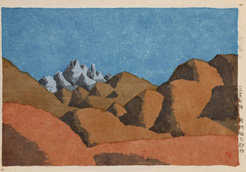
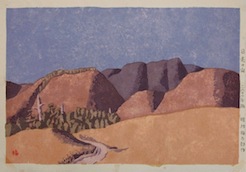
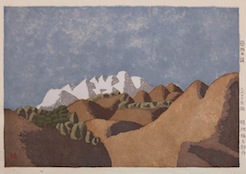
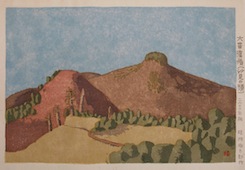
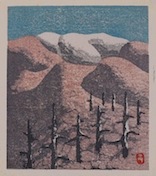
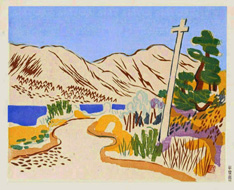
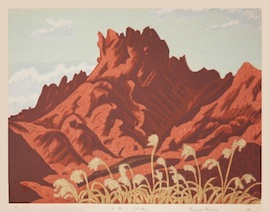
AZECHI UMETARO (1902-1999
) |
|
Born in Mima, Ehime
Prefecture in 1902, he started his career in the goverment |
|
printing office. ..At odd moments
during work, he tried his own prints scratching |
|
and scraping the lead
plate with nails and knives, and printed them in printer's ink. |
|
|
|
He made up his mind
to be an artist when he visited Hiratsuka Un'ichi with the |
|
finished works in hand
and was highly praised for their outstanding quality. |
|
In 1927 his prints
were exhibited for the first time in the 7th Exhibition of Sosaku- |
|
hanga Association,
and this led him to be acquainted with Onchi Koshiro, whose |
|
works made profound
impressions on him. In 1937, when he saw Mt.Asama |
|
erupting, he was astounded
by the total energy and after this experience on, his |
|
effortswere focused
on the main theme of 'mountain' or 'life in the mountains'. |
|
|
|
HIRATSUKA UN'ICHI (1895
-1997 ) |
|
Born in Matsue City
in 1895. On the advice of Ishii Hakutei, his master in the |
|
fine arts, he learned
the carving techniques under Igami Bonkotsu, a renowned |
|
carver. Hiratsuka himself
was later called a master carver. In 1921 his work |
|
was first exhibited
in the 3rd Exhibition of the Sosaku-hanga Association. |
|
Throughout his long
career he never spared any effort to promote this genre of |
|
art. He not only worked
as a lecturer at the government academy, Tokyo School |
|
of Fine Arts, but he
also started lectures and workshops throughout the country, |
|
thus cultivating the
soil on which grew many talents. |
|
Among them we find
Munakata Shiko as well as Azechi Umetaro, Maeda Masao |
|
and Shimozawa Kihachiro. The
latter three were called the three outstanding |
|
talents in the Hiratsuka
school. Un'ichi's passion for hanga never waned until |
|
his death at the age of 102 in
1997. |
|
|
|
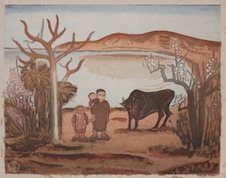
MAEDA MASAO (1904 -1974
) |
|
1904 |
Born in Hakodate City
in Hokkaido. |
|
1924 |
He met Hiratsuka Un'ichi,
who was on his lecturing tour in this northern- |
|
|
most island. Maeda
later moved to Tokyo to learn oil painting under |
|
|
Umehara Ryuzaburo,
whom he had admired, and printing under Hiratsuka |
|
|
Un'ichi. His work was
first exhibited in the 7th Exhibition of the Sosaku- |
|
1927 |
hanga Association in
1927. |
|
|
In December he joined
with Hiratsuka and the print artists in his circle |
|
|
for the first publication
of the magazine 'Han', which was continued until |
|
|
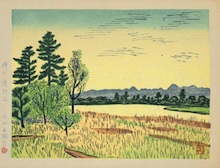
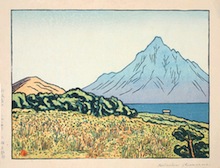
the 9th issue. His
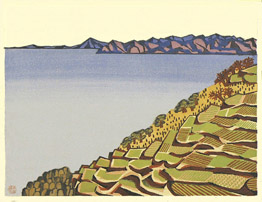
main theme was the sea in the pre-war period and |
|
|
mountains in the postwar
years. |
|
|
|
|
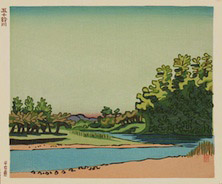
Maeda Masao, along
with Azechi Umetaro and Shimozawa Kihachiro, is counted |
|
among the three outstanding
talents in the Hiratsuka school. His collected works, |
|
however, had never
been published. We made researches into his so far unknown |
|
achievements during
the prewar period and published the result in 'Han News No.6 |
|
Maeda Masao' The works
and documents we had collected were exhibited in his |
|
hometown of Hakodate: |
|
'Maeda Masao Exhibition'
Hakodate Museum of Art, Hokkaido Jan.21- Mar.21, 2006 |
|
|
|
|
|
SHIMOZAWA (Shimoyama)
KIHACHIRO (1901 - 1986 ) |
|
1901 |
Born in Hirosaki City
in Aomori prefecture . |
|
1916 |
His enthusiasm for
art brought him far down south to Tokyo, where he |
|
|
worked for Chuo Bijutsusha
(Central Art Publishing). |
|
1921 |
He got acquainted with
Ishii Hakutei and started to paint in oil, water- |
|
|
color and tempera.
During the1921-22 period, he had to be enrolled in |
|
|
the artillery and returned
nearly deaf. |
|
1924 |
Around 1924, introduced
by Ishii Hakutei, he started to learn woodcut |
|
|
techniques under Hiratsuka
Un'ichi. |
|
1927 |
He became member of
the Hanga Association. |
|
|
Besides woodblock printing
he also composed Haiku poems. |
|
1932 |
His family name changed
from Shimoyama to Shimozawa by marriage |
|
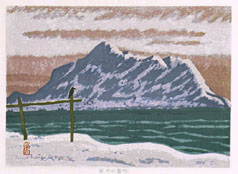
Shimozawa says, 'The
coldest winter bites my soul but brings the warmest |
|
joy when a scene is
printed beautifully snowbound' (1949) |